
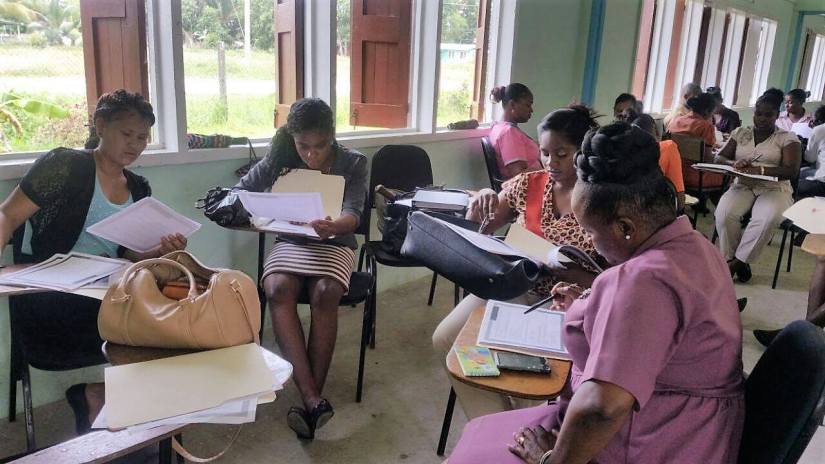
This month I struggled to decide what to write about; not because I am bereft of ideas, but because there are so many topical issues, I could not decide which should take precedence. This changed after a former colleague messaged me on Facebook to ask my opinion on the issue of teachers visiting other schools to observe best practices. Staff at my colleague’s school had been asked to observe teachers at another school. They were vehemently opposed to the idea.
My views were at variance with hers. To my astonishment, she justified her opposition to the idea with the argument that “there is nothing new I can learn from those teachers.” She added, “How much can you learn in two hours?”
I will let you pause for a moment to digest that!
Now, let us examine the two major issues at stake.
To the best of my knowledge, peer intervisitation or collaborative inquiry is not a staple of professional learning and development amongst the community of educators in Guyana. In fact, my colleague’s objection to the idea may have stemmed from a human tendency to reject newness, compounded by an approach by education officials that reeked of arrogance and condescension. To provide a little background, officials visited the school in question and found that the teachers (apparently through no fault of theirs) were not fully prepared for the new school year. They were compared in uncomplimentary terms with teachers of another school and ordered to visit that school for cues on putting their house in order. This ruffled feathers and fueled resistance to what might otherwise have been fruitful intervisitation. Because of the manner in which education officials handled the matter, they squandered an opportunity to implement a practice that is highly useful for developing teachers’ pedagogical knowledge and skills.
Peer Intervisitation is a teacher-facilitated, non-evaluative tool that uses observations from classroom visits to foster the collaborative development of teachers’ instructional knowledge and skills. It happens across subject areas, levels, and schools. This tool is a by-product of the concept of social capital, which sees social relationships as a resource through which individuals and groups can work together to achieve goals. Used or implemented wisely, it can foster professional growth by providing opportunities for teachers to observe and learn from the practices (and malpractices) of others. It helps educators to reflect on their own practices, strengthens rapport among them, and provides a forum for them to have conversations around effective instructional methodologies. In my estimation, it is an amazing professional development tool. It has served me well as a public school teacher here in the United States.
When I visited Guyana in 2016, I observed an early childhood classroom. In the short time that I was there, my knowledge of a concept was refreshed, I noticed some strategies that I felt I could take away and use in my classroom, and I also noticed some things I thought the teacher could have done differently. Because of time constraints, the teacher and I did not debrief, but I did manage to say to her, “I don’t know why we don’t do more of this in Guyana.” Peer intervisitation must become part of professional development practices in Guyana.
Which brings me to one of those two comments I paused at to let you ponder: “How much can you learn in two hours?” I’m going to discuss the ridiculousness of it only to demonstrate how ingrained and dangerous resistance to new ideas, and new ways of doing things is. I resist the notion that my colleague truly believes that two hours is NOT sufficient time to learn anything. If she does, then we might have to discredit any and every learning experience that she has completed at university that was under two hours, or any and all periods that she has taught that were fewer than two hours. I think you get the drift. This I see as a case of finding every possible objection, regardless of how deficient it might be, in support of the cause de resistance au changement. Sometimes we need to take a step outside of our emotional selves to examine an issue objectively. Education officials may have mishandled the situation but the greater considerations should be the extent to which the policy is beneficial to us in the professional learning community, and the extent to which it ultimately helps the learners in our charge.
I am still stupefied by her assertion that she cannot learn anything new from those teachers. We can learn from everyone, even the dull and the ignorant. We can learn from a person’s successes as well as from a person’s failures. Lifelong learning should be the goal of every person. It should be an aspiration of educators. If we as educators are to attain improved outcomes for our students then we must engage in reflective practices. Providing and receiving peer feedback aids this process. We must experiment with shared ideas. We must assess and reflect on the effectiveness of the different strategies/methodologies that we use in the instructional process. Collaborative approaches such as Intervisitation provide opportunities to do this and have been proven effective in improving teacher practice.
I would dare suggest that my colleague’s closed-mindedness is typical of the authoritarian educator. This type of educator believes that not only is he/she the authoritarian but also the authority. There is no need for an authority to consult with minions. As a result of this mindset, teachers and students alike are deprived of the opportunity to benefit from collaborative learning practices and communities; to learn from each other, and to build off each others’ ideas. Social capital is being squandered.
This demonstrates that education reformists in Guyana need to act urgently to correct the ingrained attitudes that are so destructive to our educational practices and the development of our human resources.

 rootsandeduculture
“Social Capital, Resistance and Reform” is an excellent thought provoking & informative presentation which is appropriate guidance for us as the modern gereration are confronted with the obsolete replicas of the by gone eras. As I read it, I was reminded of a set of Truisms, inclusive of : The more you live the more you learn & it is never too late to learn; Bertram Russel’s, Progress is impossible without changes, and if a person cannot change his own mind then that person is incapable of changing anything; and the underdeveloped minds arrives at conclusions first and then seek out only those facts that support those conclusions and neglect to consider the facts that reject them, instead of gathering all the facts, objectively analyse them , then conclude.
LikeLiked by 1 person
Great points Sherene. We are constantly learning and should definitely be open to the ideas of others.
LikeLiked by 1 person
Great treatment of the subject. I would wish to focus equally on the mishandling of the deficiency observed by the EduAdmin. It fueled the resistance and exacerbated the dilemma.
Reeducation must now go to the Higher level before, Teachers can properly benefit from the Correctional process.
LikeLiked by 1 person
Well said I so love this
I send the link to a teacher friend of mine and she thinks they should practice that here in Guyana so as to learn because every day you learn something new
She even said sometimes she learns from her students. There’s no harm in it.
LikeLiked by 1 person
Sherene, great article. I loved your handling of this dilemma. As an educator in the US (in higher education), several institutions engage in intervisitation to observe for best practices from teaching strategies to infrastructures and everything in between. Lifelong learning; the only way to do it.
LikeLiked by 1 person
Great piece of work. The world is quickly moving into that collaborative mode in all fields. The way the initiative was executed leaves much to be desired however I hasten to say the your friend should have been able to see the value and reached for the opportunity
LikeLiked by 1 person
Important and valid points made. Notably, the teacher’s response is put in context of the “authoritarian educator”. It could be assumed that the “authoritarian educator” is not just an outlier but a cultural/sub-cultural phenomenon. To that extent, the administrative culture may also be classified as authoritarian. One characteristic of authoritarian administrative cultures is the tendency to focus on ends while ignoring, or unconscious of, how a process could generate resistance. Change inherently incurs resistance. But the tone and scale of resistance, largely depend on the extent of mutual awareness and understanding of objectives, mutual participation in and responsibility for outcomes, between the teacher and the administrator, the individual and the collective. Thus, we’ll need to also revisit the assumptions, beliefs, values, ideas, practices, etc. of the administrative culture. For that culture would either enable or disable desired change. Further, we may be dealing with an even more significant issue than administrative culture and individual disposition. The norms of social and inter-organizational hierarchies may be greater constraints for which to strategize. For instance, teachers from Queen’s College (QC) would probably resent subjecting themselves to learning methods from let’s say teachers from Christ Church or some Community High School. That would be like asking Harvard to learn from the University of Guyana. It is not that personnel from QC or Harvard cannot learn a lot from the others but the social ideas of prestige, status, and the “we-them” distinctions however absurd, at the personal and social levels are real. An administrative culture, may itself be a product and instrument of these and other prejudices. So, successful change would not result without the institution first understanding itself, the other stakeholders, and the need to align individual purpose with organizational purpose.. ,
LikeLiked by 1 person
Unfortunately, any assumption about the authoritarian teacher in the Guyana context being an outlier is wishful thinking. As I pointed out in a prior post, the authoritarian teacher is, in fact, a cultural phenomenon; shaped by our colonial past and an inability or unwillingness to shift paradigms. Indeed, administrators are similarly oriented. This is evidence of the complex relationships and interactions I keep referring to. Authoritarianism begets authoritarianism. Our teachers educate our citizens who become our leaders, thought leaders, teachers and other members of our society. These citizens return to our society to imbue the various pillars with philosophical positions, policies, and frameworks that are a reflection of their education, socialization, and conditioning. It is how cultural norms are created.
LikeLike
Love the article ….I would say that attitude of refusing knowledge comes from laziness and fear !! Knowledge forces change for the most part we are too lazy to that and of course fear because we are accustomed to certain practices however negative
LikeLiked by 1 person