
LET US PLAY IT SAFE WITH THOSE BLUE LAKES, PLEASE! – Sherene Noble
Recently, the Department of Public Information in Guyana published several videos of picturesque blue lakes located in the mining town of Linden. This caused tremendous excitement over the potential for development and promotion of these areas as tourist attractions. These azure pools, set between white sand hills, are indeed a spectacle.
I too was excited about the potential for tourism that these lakes offer. However, I could not help but wonder if those in the seats of power in Georgetown are fully aware of the dangers of these lakes. Although tests have been conducted to determine the chemical levels in one lake (I question the credibility of a test conducted by one of the principals involved in promoting the lake), the presence of chemicals in the water is not the ONLY danger that might exist.
As a child, my uncles and aunts, siblings, cousins and I frequented one of these beauties at Wisroc. My grandparents lived just a few hundred meters away. When we visited them, we could not resist the pull of blue waters and white sand. I was so enthralled by Blue Lake that in 1986 I organized a sightseeing tour for my classmates from the Bishops’ High School in Georgetown. Then Prime Minister, Mr. Hamilton Green, whose daughter was among the group, provided us with a ‘tata’ bus. I proudly took my classmates, among them the daughter of the current president (if my memory serves me correct), to visit my town, and the beautiful blue lake at Wisroc. We splashed (those of us who could not swim), swam (those who could), and had a jolly good time. Then we clambered up the over-200-foot high hill to get back to civilization. We returned to Georgetown without any mishap. We were lucky, but there were many others who were not. These lakes have taken numerous lives. If only these government functionaries knew that they were sending their daughters to participate in one of the most dangerous activities a group of thirteen-year-olds could ever think to do, they would have forbidden it. They may not have known it then, and it does not seem like they know it now.
Uneven and unexpected depths
These scenic wonders are not what they seem. Unlike the turquoise Caribbean sea that gently slopes off pearl-sand beaches from shallow waters to deep, these lakes often feature underwater cliffs that can plunge a swimmer, or worse, a splasher, into unbelievably deep water.
The blue lakes are remnants of bauxite mining in Linden. This process involves the removal of up to 250 feet of overburden to access the precious mineral. The removal of the overburden and bauxite creates giant craters which then fill up with water from rainfall and underground sources, as well as runoffs from the mining process itself. A major hazard of these mined out areas is the uneven and unexpected depths. When mining is being done, there is no consideration for future use as a recreational facility hence there is no gradual sloping from shallow to deep. One might find oneself standing in three feet of water and with a single step shift to depths of as many as 300 feet. This can pose a problem even for the most experienced of swimmers.
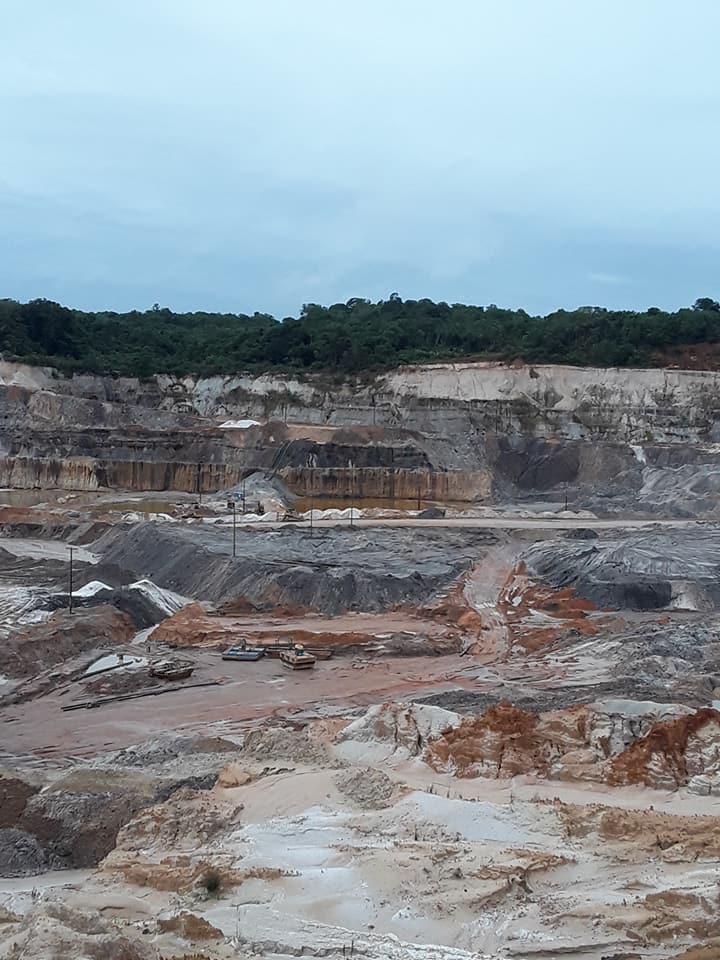 The East Montgomery Mine in Linden (Picture courtesy Michelle Johnson)
Additionally, with such drastic changes in depths, comes an accompanying lowering of the water temperature. This may seem like not a big deal. However, scientific studies have shown that a fall in skin temperature resulting from being suddenly submerged in colder water, causes “cold shock”, a cardiorespiratory response which may act as a precursor to drowning.
Quicksand
At Mackenzie, one such crater is used as a pond or holding area for effluent from the Bauxite processing plant. The area is called the Washer Pond. It is known for being one of the most dangerous places in Linden. Apart from containing chemicals and residue from bauxite processing, it is also a catchment area for quicksand or ‘suck sand’. Quicksand is a hydrogel that is made up of material such as sand, silt or clay, and water. Quicksand forms in saturated loose sand. The sediment may appear solid but when pressure is applied, liquefaction occurs. The sand forms a suspension with the liquid and loses strength. In other words, what might appear to be solid ground, could quickly give way under a person’s weight and become a deathtrap. This, unfortunately, is another feature of these blue lakes.
In Malaysia, which has a similar problem of people using mined out areas as recreational facilities, and where numerous people die every year as a result, activists are campaigning for the government to impose strict regulations to limit access to and use of these areas for swimming. In Guyana, the government has more or less sanctioned the use of these lakes for tourism purposes. Some of these areas may turn out to be quite safe but we would not know for certain unless we exercise due diligence. The Guyana government needs to conduct comprehensive and INDEPENDENT tests, not only to determine the levels of chemicals in the water but also to determine water depths and the presence of quicksand. It is the sensible thing to do.
 rootsandeduculture