
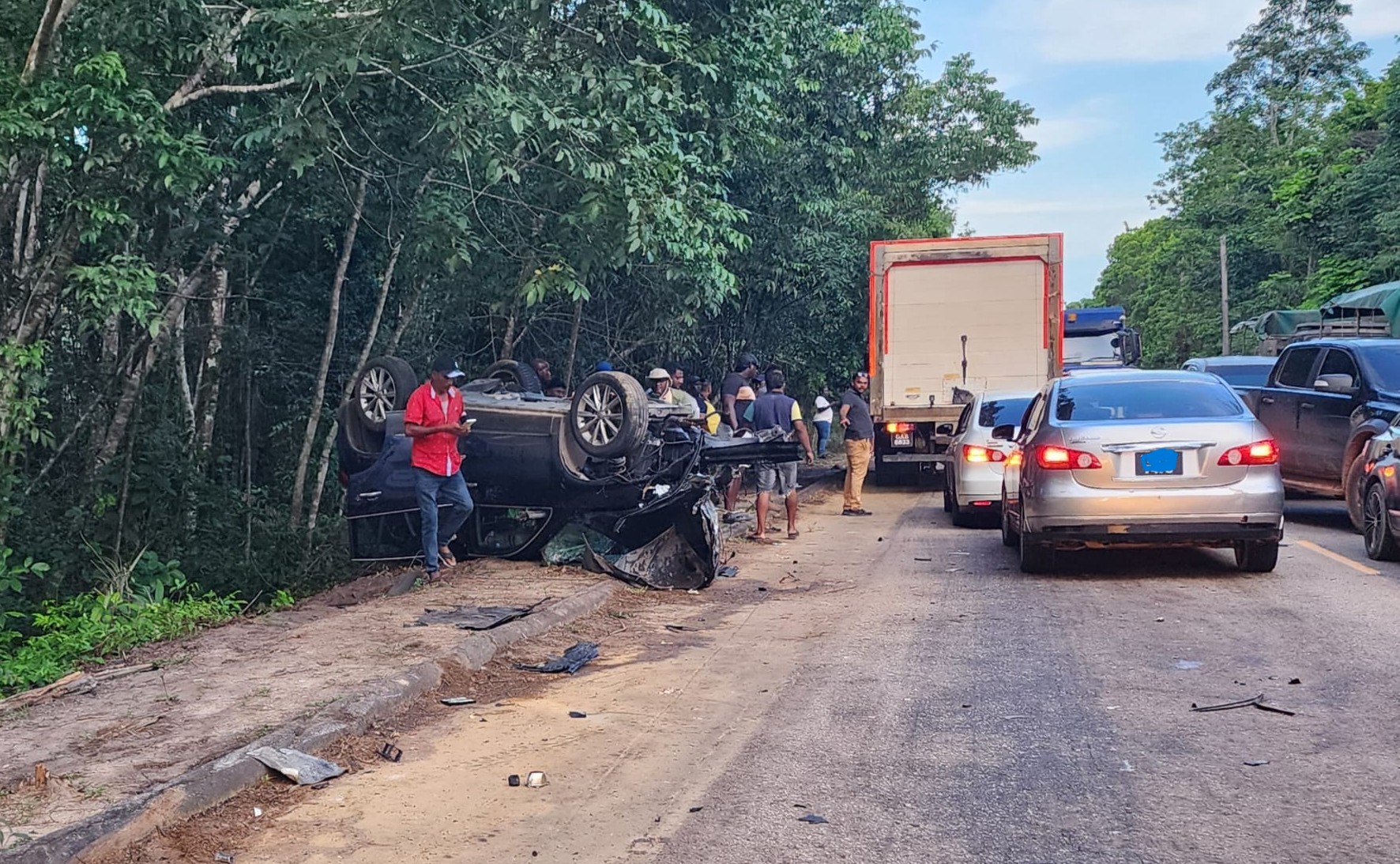
Road deaths are one of the leading causes of death in Guyana. This stark statement was made by Traffic Chief, Senior Superintendent Mahendra Singh, in Kaieteur News on November 18, 2024. As of that time in 2023, 151 people had died on Guyana’s roads, a staggering 71% increase from the 88 fatalities recorded in 2022. This represents 0.019% of the total population, assuming a population of 800,000. In contrast, New York City, with its population of 8.5 million, recorded 259 traffic fatalities, accounting for just 0.003% of its population. To describe the situation in Guyana as alarming would be an understatement.
Despite repeated governmental interventions and increasingly stringent measures, road fatalities persist. This suggests not merely a failure of implementation, but a deeper misdiagnosis of the problem itself. When solutions fail repeatedly, it is often because they address symptoms rather than root causes. I argue that Guyana’s approach to road safety reflects a pattern of systemic misalignment in which surface-level interventions obscure deeper structural and cultural deficiencies.
In The Fifth Discipline (1990), Peter Senge defines a learning organization as one that continuously expands its capacity to create desired results through five interrelated disciplines: Systems Thinking, Personal Mastery, Mental Models, Shared Vision, and Team Learning. These disciplines provide a powerful framework for diagnosing complex organizational/societal challenges. When applied to Guyana’s road fatality crisis, they reveal not only flawed interventions but also entrenched learning disabilities that prevent meaningful change. Specifically, this crisis reflects three of Senge’s key systemic patterns: “the easy way out leads back in,” “the enemy is out there,” and “the illusion of taking charge.” Each of these is rooted in failures across multiple disciplines.
The Easy Way Out Leads Back In
This principle highlights the tendency to apply short-term, symptomatic fixes to complex problems. Such responses often produce temporary relief but ultimately reinforce the original issue. For example, identifying drinking and driving or inattentiveness as causes of road fatalities appears logical. However, framing these as primary causes reflects a linear rather than systemic understanding of the problem. Systems Thinking requires us to examine interrelationships rather than isolated events. Why do such behaviors persist? What systemic conditions allow them to flourish?
A critical issue lies in the driver licensing system. If licenses are obtained through questionable or insufficiently rigorous processes, then the system itself produces underprepared drivers. This reflects a failure of Personal Mastery, as individuals are not being held to high standards of competence, and a failure of Mental Models, as society normalizes inadequate preparation and unsafe practices. The anecdote of a police officer involved in a fatal crash that killed multiple individuals illustrates this point. The debate centred on “right of way,” yet ignored the broader responsibility of safe driving. This reflects a flawed mental model: that legality equates to safety. In contrast, effective systems prioritize outcomes over technical correctness. As observed in a similar situation in Brooklyn, officers chose to disengage from the pursuit to prevent potential harm. This demonstrates a systems-oriented mindset where preserving life takes precedence over procedural enforcement. Without addressing these underlying systemic and cognitive issues, efforts to curb unsafe behaviors will continue to “loop back,” reinforcing the very problem they seek to solve.
The Enemy Is Out There
The “enemy is out there” mindset reflects a tendency to externalize blame. In the context of road safety, this manifests in attributing responsibility solely to road users. Statements such as “it’s you, the road users” reflect a deeply entrenched mental model that positions individuals as the problem while absolving institutions of responsibility. However, systems thinking challenges this perspective by emphasizing that behavior is shaped by systems.
Institutional practices play a critical role in shaping road culture. Weak enforcement, inconsistent application of laws, corruption, and inequitable consequences all contribute to a culture of noncompliance. If individuals perceive that rules can be circumvented or selectively enforced, unsafe behaviors become normalized. This also reflects a failure of team learning. Effective systems require collective reflection and shared accountability across stakeholders, including law enforcement, policymakers, and the public. Without open dialogue and critical examination of institutional practices, the system remains locked in a cycle of blame and inaction. To move forward, leaders must challenge their own assumptions and engage in reflective inquiry:
- How do institutional practices reinforce unsafe behaviors?
- Are enforcement mechanisms fair, transparent, and consistent?
- What cultural messages are being communicated through policy and practice?
Only by shifting these mental models can meaningful change occur.
The Illusion of Taking Charge
Senge argues that what often appears to be proactive leadership is, in reality, reactive. This illusion is evident in the repeated introduction of initiatives that mirror previous efforts but fail to produce sustained outcomes. Proposed measures such as awareness campaigns, infrastructure improvements, and public education are not inherently flawed. However, when implemented without a coherent, system-wide strategy, they become fragmented responses to symptoms rather than drivers of transformation. This reflects a failure to establish a shared vision. A shared vision is not simply a set of goals imposed by leadership, but a collective commitment to a desired future. In the absence of such alignment, initiatives lack coherence, ownership, and sustainability.
The “Do The Right Thing” campaign from a few years ago, for example, relies on individual compliance rather than cultivating a collective cultural shift. Without addressing systemic inconsistencies and reinforcing shared values across institutions, such campaigns remain superficial. True leadership requires moving beyond visible action to deep structural change. This involves aligning policies, enforcement, education, and cultural messaging within a unified vision of road safety.
A Systems-Based Approach for Real Change
To break the cycle of ineffective interventions, Guyana must adopt a fully integrated, systems-based approach grounded in Senge’s five disciplines:
- Systems Thinking: Examine the interconnected factors influencing road safety, including licensing, enforcement, culture, and infrastructure.
- Personal Mastery: Establish rigorous standards for driver competence and professional accountability within enforcement agencies.
- Mental Models: Challenge societal beliefs that normalize unsafe behavior or justify noncompliance.
- Shared Vision: Develop a national commitment to road safety that is collectively owned and consistently reinforced.
- Team Learning: Foster collaboration among stakeholders to reflect, adapt, and improve practices continuously.
Internalized Conformity as a Cultural Shift Mechanism
Sustainable change requires more than compliance; it requires internalized conformity. This occurs when individuals adopt safe behaviors not out of fear of punishment, but because these behaviors align with their internal values. Research supports this progression. While external consequences can initiate behavior change (Gneezy & Rustichini, 2000), long-term transformation depends on the internalization of moral and social norms (Kohlberg, 1981) and the development of habitual behaviors through reinforcement (Bandura, 1977).
However, this process is contingent upon fair and consistent enforcement. When rules are applied selectively or can be bypassed through informal means, they lose their legitimacy. This undermines both shared vision and mental models, reinforcing the belief that compliance is optional.
To achieve internalized conformity, consequences must be:
- Consistent
- Equitable
- Meaningful enough to influence behavior
For example, minor fines may fail to deter violations, whereas significant consequences, such as license suspension or revocation, can prompt reflection and behavioral change. Similarly, when a traffic officer accepts GY$5,000 to overlook a traffic violation, the enforcement system is compromised, weakening deterrence, reinforcing noncompliance, and undermining both fairness and the development of internalized adherence to road safety norms.
Fairness as a System Imperative
A critical condition for systemic change is fairness. A system perceived as unjust cannot cultivate internalized conformity or collective commitment. When rules apply differently based on status or influence, the system communicates that compliance is negotiable. This erodes trust, weakens shared vision, and reinforces counterproductive mental models. For meaningful reform to occur, everyone must be held to the same standards. Only then can a culture of accountability and responsibility take root.
Support literacy development in Guyana by contributing to our reading program. Click here for our GoFundMe.
Legends of the Black Water is available on Amazon.
Bandura, A. (1977). Social learning theory. Prentice Hall.
Gneezy, U., & Rustichini, A. (2000). A fine is a price. Journal of Legal Studies, 29(1), 1–17.
Kohlberg, L. (1981). Essays on moral development: Vol. 1. The philosophy of moral development. Harper & Row.
Senge, P. M. (1990). The fifth discipline: The art and practice of the learning organization. Doubleday.
Singh, M. (2024, November 18). Road deaths among leading causes of death in Guyana. Kaieteur News.
 rootsandeduculture