
I stumbled upon Baby Skello’s now-infamous song, which references the Hindu deity Mother Lakshmi in a vulgar and offensive manner. It’s not just disrespectful—it is disgraceful. Listening to it was a jarring experience, not just because of its irreverence, but because it reflects a broader cultural erosion that seems increasingly normalised in popular music. Much of today’s dancehall music is so riddled with vulgarity and obscenity that I find myself, a genuine lover of the genre, questioning whether some form of censorship is necessary to protect the public from this cultural onslaught.
I’m not here to judge anyone’s musical tastes; to each his own. I enjoy dancehall. I love soca and calypso. And let’s not pretend these genres have not flirted with risqué content. The Mighty Sparrow was the king of double entendre. Even our beloved Dave Martins and the Tradewinds released an album that was banned from the airwaves for tracks like Motor Car and Woman in Love. So yes, art can be provocative, playful, and even edgy.
But what I’m grappling with is the role of government in promoting what amounts to cultural degradation. A line must be drawn when the state—the highest custodian of national values—appears to actively promote art that undermines the very cultural and moral fabric of the society it claims to represent. When figures like Vybz Kartel of “Good Like Jesus” fame, are given pride of place at national events, or when artists like Spice—of “Skin Out Yuh Pum Pum” notoriety—are invited to headline Independence celebrations, the state is no longer a passive observer of cultural shifts. It becomes an active participant in the dilution of cultural integrity.
Culture, as anthropologists remind us, is not merely the sum of our music, dance, and festivals. It is the complex web of beliefs, practices, values, and symbols that shape collective identity. It permeates education, governance, interpersonal relations, and nation-building itself. As such, the symbolic choices of government—who it honours, who it platforms, and what it celebrates—have a profound impact on the social consciousness. Pierre Bourdieu’s concept of habitus helps explain how these cues shape people’s perceptions of what is normal, acceptable, and aspirational. Similarly, Social Representation Theory posits that ideas become entrenched in public consciousness through discourse, media, and shared institutions. In other words, what the government promotes becomes what the society internalizes.
There is also a more practical consideration: the question of sovereignty. How does it serve the purpose of national independence to import foreign acts to headline our most symbolically significant celebrations? The irony is striking. I am not aware that any other nation celebrates its autonomy by outsourcing the soundtrack of its freedom.
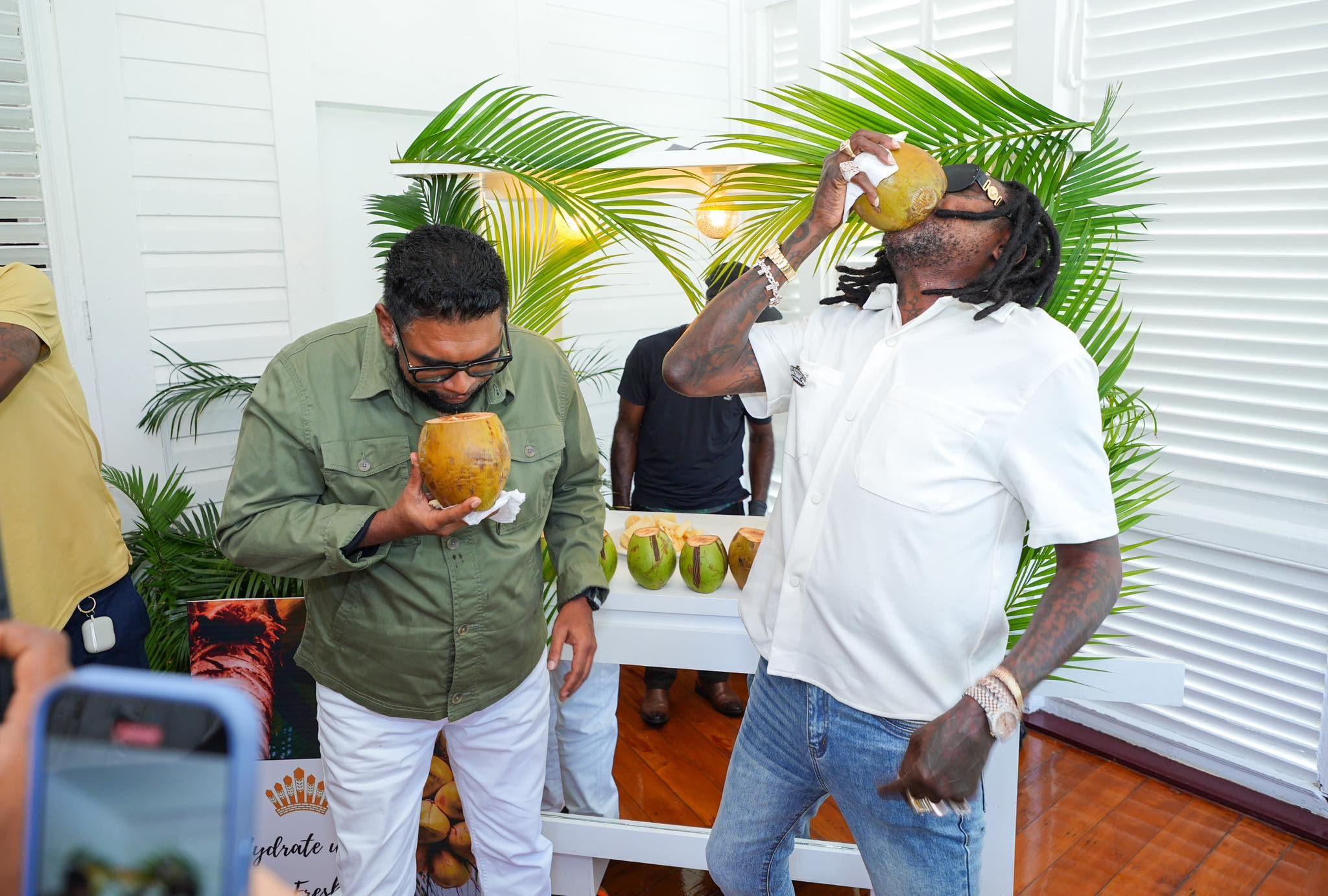
President Ali hosts Vybz Kartel at State House (Image courtesy President Irfaan Ali Facebook)
Admittedly, some artists may not fully understand the cultural or religious implications of their work. In the case of Baby Skello, it might be unfair to assign full blame if he lacks the educational or cultural sophistication to recognize the harm such choices can cause. But national leaders, by contrast, have a responsibility to demonstrate discernment. Their actions set the tone for the broader society. Leadership entails not just policy but symbolic guidance. I recently saw a video of an ordinary Jamaican citizen calling out President Ali for endorsing Vybz Kartel. When it reaches that level, when even non-Guyanese are publicly questioning our leadership’s choices, you know the problem has hit rock bottom.
What is perhaps most disheartening is the seeming resistance to constructive critique. Public discourse is often mischaracterized as political hostility rather than as an opportunity to reflect and recalibrate. But a healthy democracy thrives on dialogue, especially when it concerns cultural integrity and national identity and the government would do well to embrace it.
The embrace of vulgarity and spectacle in spaces meant for reflection, pride, and unity is not just a cultural oversight—it is a political failure. If we are to preserve the soul of the nation, then those entrusted with its stewardship must rise to the task of protecting, not prostituting, our culture.
Baby Skello has since issued an apology. It is now the government’s duty to adjust its posture to guide its citizens toward a path that does not lead to cultural degradation. If the Ethnic Relations Commission (ERC) sees it fit to sanction Baby Skello, then consistency demands that it also issues a stern reprimand to the Government of Guyana. After all, it has actively embraced and promoted artists who are equally—if not more—guilty of vulgarity, irreverence, and cultural insensitivity. Accountability must not stop at the artiste. It must reach those who have the power, influence, and responsibility to set the standard.
Hit like and subscribe to receive more content.
Grab your copy of Legends of the Black Water – a collection of short stories by Sherene Noble

 rootsandeduculture
SISTA, YOU ATE AND LEFT NO CRUMBS
YOU A POWERFUL WITH YOUR PEN
THSES SO MANY POINTS MADE THAT CAN BE STUDIED A GREATER LENGTH.
LikeLike